The role of terminal blocks
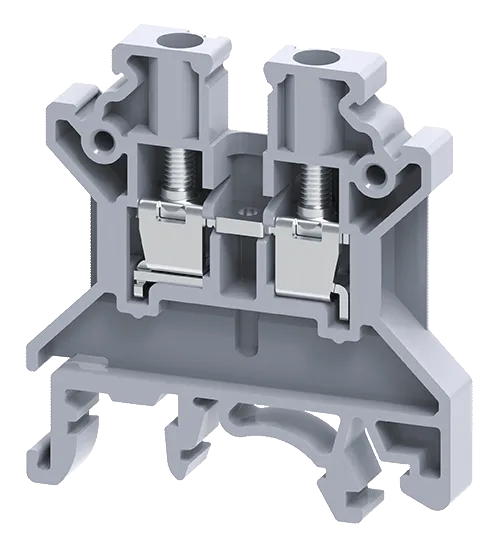
A terminal block is an insulated, DIN-rail-mounted connector that joins two or more wires through a conductive current bar. In a control panel, terminal blocks form the clean interface between field wiring and internal wiring – making installation, testing, troubleshooting and modification faster and safer.
Connectwell terminal blocks on our catalog are made from polyamide, available in several colours, rated for DIN 15/32/35 rails depending on the model, and accept accessories such as shorting links, end plates and marking tags.
Connection technologies
| Technology | How it clamps | Strengths |
|---|---|---|
| Screw | Screw presses the clamp onto the conductor | Universal, suits solid and stranded wire |
| Spring clamp | Spring opened with a screwdriver, closes on release | Fast wiring, resists loosening under vibration |
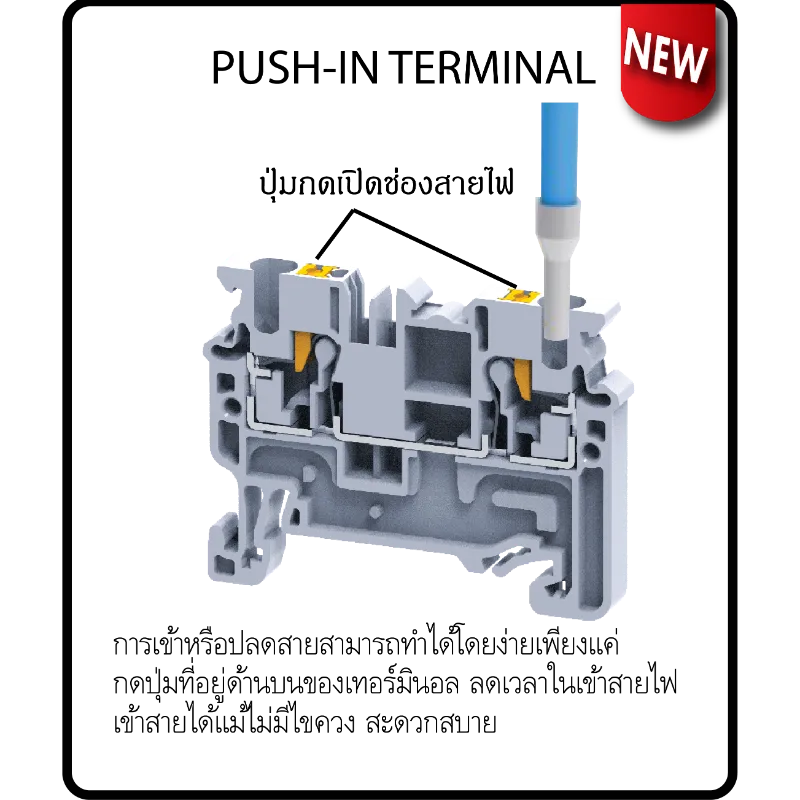
| Push-in | Solid or ferruled wire is pushed in directly; push button to release | Fastest wiring, tool-free insertion |
| Stud | Ring or fork lug fixed with a nut | Very secure, high currents and large cross sections |
Common functions
- Feed-through – the standard pass-through connection.
- Double / triple level – more circuits in less rail space.
- Ground (PE) – green-yellow blocks that bond to the DIN rail.
- Fuse – with fuse holder and optional LED indication.
- Disconnect & test – isolate a circuit for measurement without removing wires.
Selection checklist
- Rated voltage and current for the circuit.
- Conductor cross-section range (mm² / AWG), with or without ferrules.
- Connection technology suited to vibration and wiring time.
- Function: feed-through, multi-level, ground, fuse or disconnect.
- Accessories: end plates, end clamps, shorting links and markers.
Frequently asked questions
Spring or push-in for machines with vibration?
Both resist loosening from vibration better than screw terminals because the spring keeps a constant contact force. Push-in additionally allows tool-free insertion of solid or ferruled conductors.
Sample article for the prototype — content to be reviewed by the AZGA technical team before publishing.
Need help applying this to your project?