
On this page
What an MCB does
A miniature circuit breaker (MCB) protects cables and equipment against overload and short circuit. Its thermal element trips on sustained overload; its magnetic element trips instantly on short-circuit current. MCBs for installation use are covered by IEC 60898-1; devices for industrial use are often also rated to IEC 60947-2.
1. Rated current (In)
Choose In so that the design current of the circuit is below In, and In is below the current-carrying capacity of the cable after derating for installation method, grouping and ambient temperature. Panel interiors run warm — check the manufacturer’s temperature derating.
2. Tripping curve
| Curve | Magnetic trip (× In) | Typical loads |
|---|---|---|
| B | 3 – 5 | Resistive loads, long cable runs, lighting |
| C | 5 – 10 | General industrial and commercial circuits, small motors, transformers |
| D | 10 – 20 | High inrush loads: motors, transformers, welding equipment |
The curve must avoid nuisance tripping on inrush while still clearing a short circuit quickly enough at the end of the cable.
3. Breaking capacity
The breaking capacity must be at least equal to the prospective short-circuit current at the point of installation. Close to large transformers this can be high. For example, the Eaton range we list includes PLS6 (6 kA), PLSM (10 kA) and PLHT (up to 25 kA for 20–63 A) – the higher the fault level, the higher the rating you need.
4. Poles and additional protection
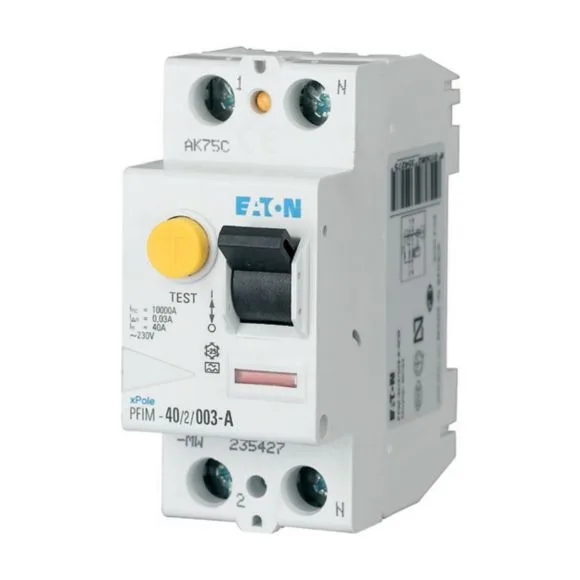
Select 1P, 1P+N, 2P, 3P, 3P+N or 4P according to the supply system and whether neutral must be switched. Where protection against earth leakage is needed, use an RCCB in combination with MCBs, or an RCBO (such as Eaton PKNM) that combines both functions. For fire risk from arcing faults, consider an AFDD.
Frequently asked questions
Is a higher breaking capacity always better?
It must be at least the prospective fault current at the installation point. Choosing far above that adds cost without additional benefit, but never choose below it.
B or C curve for a control panel?
C curve is the most common choice for general control circuits with power supplies and small motors; B curve suits purely resistive loads or long cables where fault currents are low.
Sample article for the prototype — content to be reviewed by the AZGA technical team before publishing.
Need help applying this to your project?